
THE ARCHIVE: Interview with James Edwards, Group General Counsel at Zenith Vehicles
Think Legal Recruitment has been building in-house legal teams across the UK for years, working with GCs, Heads of Legal and Senior Legal Counsel at organisations across every major sector.
The Archive is our long-form interview series with General Counsel and senior in-house lawyers across the UK. Each record is a candid conversation about the route in, the reality of the role, and where the profession is heading.
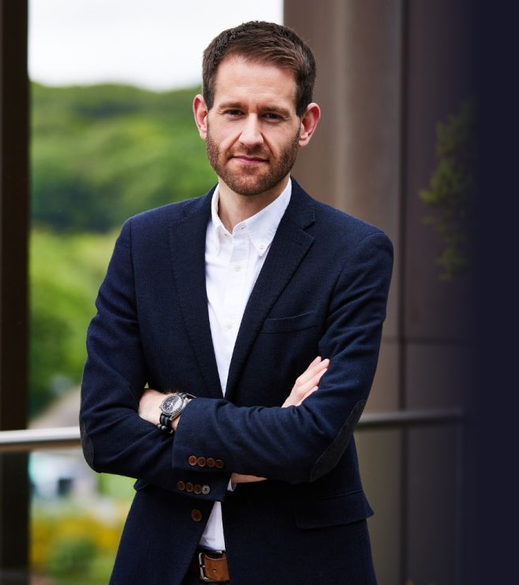
Our second record is with James Edwards, Group General Counsel at Zenith Vehicles. Most people file Zenith under car leasing. James would rather you understood it as a strategic fleet partner navigating the shift to electric, with a thirteen-strong Legal and Compliance team he cheerfully describes less as a profit centre and more as a profit leakage avoidance centre!
James took the GC role in March 2020, three weeks before lockdown, which he calls a baptism of fire. He talks about legal as a decision partner rather than a risk blocker, about the quiet cost of being a trusted advisor, and, by his own admission, about what nine strangers around a casino poker table taught him about managed risk. Warm, self-deprecating and honest. We enjoyed this one.
Interviewed by: Adam Zdravkovic and Andy Balmer

Most people have a surface-level understanding of what Zenith does. What do they tend to get wrong, and what would surprise them about the business?
I think most people see Zenith as just a car leasing company, which is a bit of an oversimplification. In reality, we're much more of a strategic fleet partner and act as an outsourced fleet function for some of the UK's biggest and well-known businesses. As the transition to electric gathers pace, we're working closely with clients of all shapes and sizes to help them on that journey – and it's really interesting and great fun!
What does the legal function look like here, and where does it sit in terms of real influence within the organisation?
We have 13 colleagues across Legal and Compliance, all from different backgrounds, experience, and qualification. Whilst we all have our own little specialisms or interests, we get involved in everything – including often things that aren't 'legal'. And it's there where I think we add the most value.
We're not a profit centre, we're more a 'Profit Leakage Avoidance Centre' (!), challenging how we do things and can we do it better or differently, whilst staying compliant.

Take me back to before law. Who were you, what were you pointed towards, and was law a calling or a calculation?
It's quite simple for me. I'm not sure they still do it but back at school you could fill in all these questions about yourself and the computer (pre-AI, I may add) pumped out your career. Mixed between Chef, Police Officer and various other random jobs was Lawyer.
I have family links to the law but had never really thought about it as a career option. It was however a close call between Lawyer and Police Officer - although I thought the odds of being stabbed was less being a Lawyer...
What did you think the job was going to be, and what turned out to be completely wrong about that?
I'm not sure I ever thought properly about what it would be, other than it was something at the right time in my career I wanted to have a go at. Things don't always go to plan, however. I took the role of GC in March 2020 and three weeks later the country went into lockdown. It was a baptism of fire for everyone with lots of unknowns, and for me new in role especially. There's no 'user manual' of how to do the job, we just do the best we can and hope that if, or when, we hand it over, it's in a better place than how we received it. I also think that being a manager or a leader of a team is HARD, and lawyers traditionally don't get trained on that.

How do you hold the line when the business wants you to find a way to say yes, and the right answer is no?
This happens regularly. Not necessarily because the 'no' answer means it would be an offence and people would go to jail (that doesn't happen here…), rather stakeholders wanting to push on but haven't always considered every angle. We try and get ahead of that by ensuring we are involved in processes right at the start, even if it's just on a visibility brief. I think I've rarely said 'no', instead it's 'have you thought about this' or 'checked that'.
GCs talk about being a 'trusted advisor', but what does trust actually cost you?
Being a trusted advisor absolutely has a cost, it's not about being liked all the time, it's about being relied on when it matters. First, you have to be willing to say uncomfortable things early. I've learnt the hard way not to throw a grenade into a conversation unless you're willing to jump on it straight after.
Second, you have to take ownership beyond pure legal advice. If you only describe the risk and walk away, you're a technician. Trusted advisors stay with the problem, help shape the outcome, and share accountability for the decision, even when there isn't a perfect answer.

What do you look for when you hire that doesn't appear in any job description?
I've been in trouble with HR before because I look for the right 'fit'. And when questioned I couldn't articulate what that was – which was fair. We've hired less qualified individuals before because they could articulate that drive and show how they went after it. Our stakeholders don't want memos or case law, they want commercial lawyers – commercial first. We've hired from both private practice and direct from in-house, and one doesn't necessarily hold more weight than the other.
What do you owe the people in your team in terms of their development, and how do you actually deliver on that?
I think you owe your team three things on development: clarity, opportunity, and advocacy. People can't develop if they don't know what “good” looks like. Development doesn't happen through training alone. It happens through exposure. So, we try to give everyone stretch work slightly ahead of where they're comfortable, but with the right support around them. A big part of my role is what happens when the team are not in the room. I don't want anyone to leave of course, but if they have grown and developed whilst at Zenith and it's just time for something different, whilst bittersweet they'll always have our blessing.

What's a widely held belief about the in-house legal world that you think is wrong?
That in-house lawyers are primarily there to minimise risk. That's partly true, but I think the better framing is that we're there to enable smart risk-taking. If legal is only seen as the function that says 'no' or slows things down, you get brought in late, your advice is worked around, and ultimately risk increases, not decreases. Another misconception is that independence means distance. I actually think it's the opposite. You earn the right to be independent by being deeply embedded and understanding the business properly. So, for me, the role isn't 'risk blocker' or even just 'risk adviser', it's decision partner.
Has AI changed anything about how your team actually works yet, or is it still mostly talk?
We use CoPilot, and I both love it, but it also scares me considerably. In our team, the biggest change so far has been around efficiency, sense checks, research, and summaries. That's taken some of the lower-value, time-intensive work out of the system and freed people up to focus more on judgment, negotiation, and stakeholder engagement. We use it as a support tool, but it doesn't replace. Indeed, on numerous occasions it has been wrong or led the user down a rabbit hole – me included!

What do you think the GC role will look like in ten years, and are you optimistic or cautious about that?
I think the GC role in ten years will be broader, even more embedded in the business, and more explicitly tied to value creation, but the core of the role will still be judgment and trust. At the same time, I think the role will become more multidisciplinary.
You're already seeing legal, compliance, risk, ESG and sometimes even corporate affairs converging. So, the GC becomes less of a pure legal specialist and more of a governance and risk leader, but always with a commercial lens. Where I'm slightly cautious is around capacity and expectations. As the role expands, more responsibility, more visibility, more complexity, there's a risk that everything gets pulled into the GC remit without always the corresponding resource or clarity of mandate.

What do you do that has nothing to do with law, that has somehow made you better at it?
Without judgement please, I used to play a lot of poker. Not online but around a table of 9 strangers at a casino. At a surface level it's obviously unrelated, but the underlying skills translate quite closely. Making decisions with incomplete information, under time pressure, and with real consequences, which is not that different from a lot of in-house legal work! You're very rarely making perfect decisions. You're making the best decision you can with the information you have and being comfortable with the fact that even a good decision can lead to a bad outcome. I found it also sharpens your read of people and incentives. Unfortunately I don't have much time to play anymore but if you see me at a table some random Friday night with my head in hands… come say hello!
What's the question you'd most want to be asked in an interview like this, that nobody ever asks?
“Would you ever go back to private practice”. No (at least not yet). I love the in-house world too much, the ups and the downs and being able to see the tangible results of hard work. For example, whilst no one ever really reads it, I feel some degree of pride that the Privacy Notice on the Zenith website was drafted by the Legal Team!
Without saying where, at one interview I was asked 'How would you describe a spiral staircase without using the words spiral or staircase'. I must have answered it in some meaningful philosophical way as I got the job. Later on, I was told the back up question alternative was “How would you describe Monster Munch to someone.” Random but fun!
What's the most important thing you know now that you wish you'd understood earlier?
That being right is much less important than being effective. Early on, I focused a lot on getting to the technically correct answer and making sure it was properly articulated. And that obviously matters, but on its own it doesn't necessarily change outcomes. And finally, I now see that relationships are not a 'nice to have' alongside the work. They are 100% part of the work. If I could go back, I'd spend less time trying to be the most technically complete voice in the room, and more time focusing on how to be the most useful one.
What do you hope someone reading this in the future will learn from it?
Probably that there isn't a 'right way' to do this role, and if you're waiting to feel fully ready before stepping into it, you probably never will. Back yourself, stay curious, ask questions, and focus on being useful rather than perfect. Oh, and play more poker.
OFF TOPIC, ONE FOR FUN
What is your current favourite restaurant, and why? What do they serve?
Hickory's Smokehouse. BBQ food, authentic American style and taste, and great beer!


